|
BANDING WITH MANUEL The local refinery is the main employer for Minatitlan's population.
Fifteen years ago, failure of outdated 80-year-old equipment caused
a major oil spill. Money for environmental research was allocated in 2008. At this point, Pemex refinery took the initiative to start bird monitoring, and in October 2010 a full-time, year-round banding station was established with Manuel Grosselet as master bander in charge. The station monitors spring and fall migration, as well as winter survivorship and is one of a kind. Since start-up six months ago, over 128 species and 10 000 birds have been banded, and 282 species observed. Meet the banding team Manuel Olivier Grosselet, who runs the station, is a legend in North America's banding community. Since 1988, he has participated in various bird monitoring programs in Europe, North Africa, Central and North America, and been recognized by the French and Canadian governments as a specialist in bird monitoring. He has banded more than 70,000 birds in 10 countries, and personally handled about 500 species. He is a member and advisor of many birding organizations in many countries, as well as author of many publications, books and birding guides. Manuel has many plans. One of his ideas is to create an international training center for Latin American and other banders. He can be contacted through his website www.tierradeaves.com Monroy Ojeda, second-in-command, is a Natural Resources Management Engineer, a wildlife management specialist, and a very knowledgeable and experienced bander. His international experience includes banding at Long Point, Ontario. Two biology students also assist at the station. Manuel is proud of his team. They work continuously for three seven-day weeks, having the 4th week free to see their families. My first day My first day of banding ended with 267 birds banded (from 10 nets in 4 hours). |
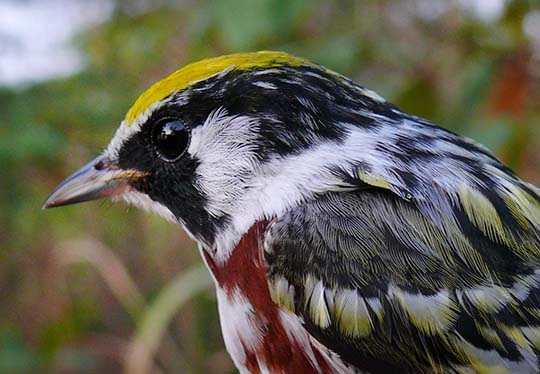
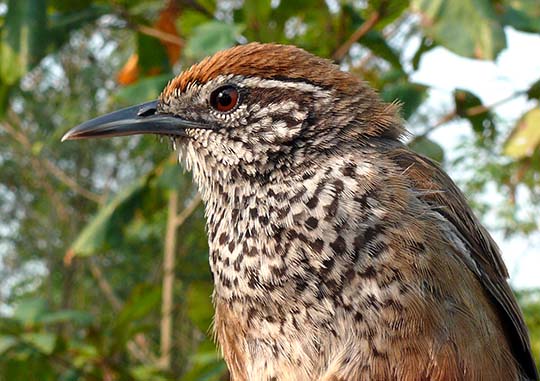
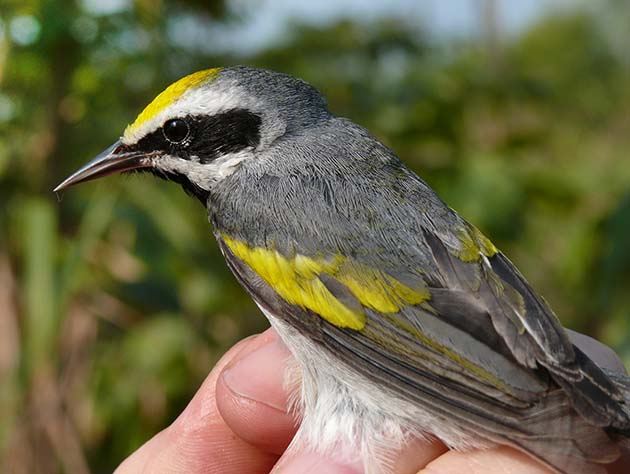
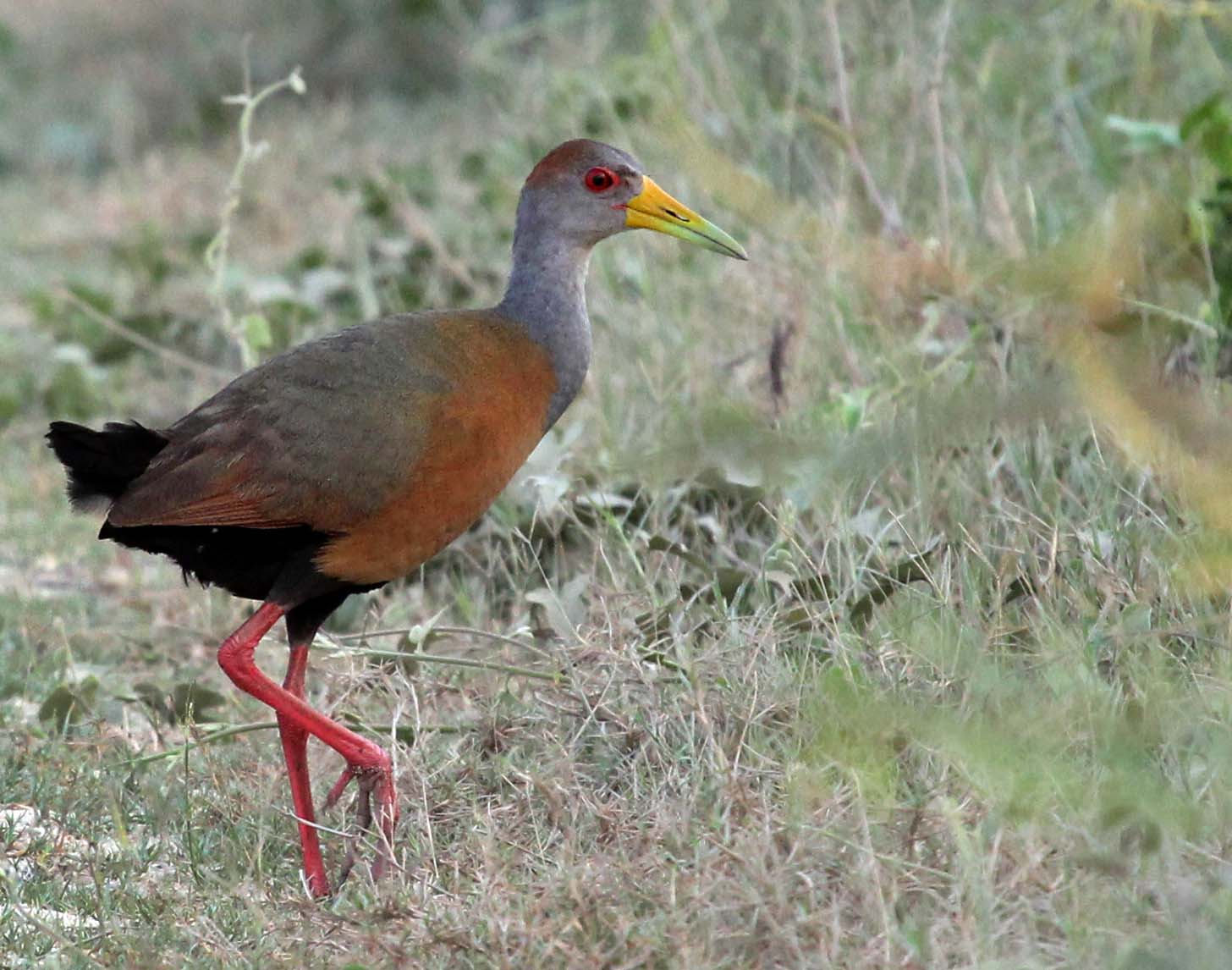 Grey-necked Wood Rail I extracted and banded two firsts for the station: Golden-winged and Chestnut-sided warblers. It was a day of 92 Yellow-breasted Chats, as well as many stunning Painted and Indigo buntings. The number of birds and variety of species was so exhilarating that 30 degree Celsius heat and tiredness passed without notice. It was an amazing learning experience. I also realized how grateful I should be for my early training with Derek Mathews at our station in Vancouver. Some other species included Mourning, Kentucky, Tennessee, Canada, Hooded, and Worm-eating warblers, Grey-cheeked Thrush, Spot-breasted Wren, Greyish Saltator, Common Ground Dove, Brown-crested and Great Crested flycatchers, Green-breasted Mango, and Black-billed Cuckoo. Daily Routine It's April and spring migration. The day starts at 6 am. with a short drive to the station and the opening of 10 mist nets, which almost instantly are filled with birds of many species. Nets are open from 6:30 to 10:30, so the next 4 hours are extracting and banding time with no break. Then the nets and poles have to be dismantled and packed into the truck. Arriving back at city headquarters about noon, the next hour is dedicated to computer data entry. At 2 pm the whole team goes for lunch at a local restaurant and then returns to headquarters for rest. At 5:30 we drive back to the banding station to set up the nets,
making them ready to be opened the next morning.
|
Weekly rotating team members stays
overnight in a tent, to be ready at 2 am to activate playback (sound
recording of bird songs) to attract night migrants. This technique
proved to be quite effective. One night we went with portable nets
to capture a Spot-tailed Nightjar, and another night we photographed
a Striped Owl. We return to the headquarters at 8 pm, and at 9 we
walk to the restaurant for supper.
Good-bye My short visit came to an end all too
soon. It was time to say my good-byes to Manuel, his team, the
friendly atmosphere, and go home. The incredible number and
diversity of the bird species will remain in my heart. I'll be back
for the fall migration. Vancouver Connection The reason I was able to get so much
from my time at Manuel’s station was because of the amount of
experience I had previously gained from working at the Vancouver
Avian Research Centre (VARC) here in Vancouver.
Photographic documentation of this event can be seen at: birdsphotography.com/country/mexico_veracruz
|